Penetration Dynamics Shape Decision Patterns Across Blackjack Variants
Olivia Keller · Jun 17, 2026
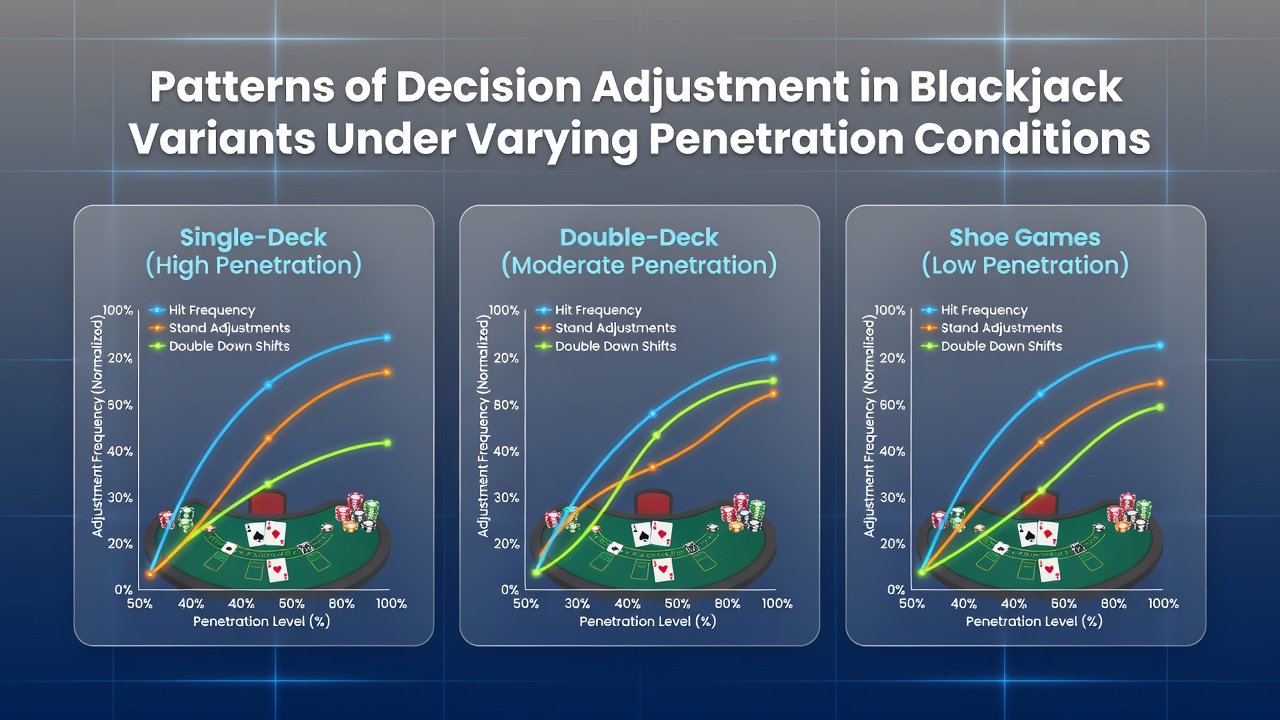
Penetration Dynamics Shape Decision Patterns Across Blackjack Variants
Analysts track how penetration levels in blackjack shoes trigger measurable shifts in player decisions, and these patterns vary across game variants because rules on doubling, splitting, and surrender interact differently with remaining deck composition. Researchers collect data from live sessions and simulations to identify thresholds where basic strategy charts require index adjustments, particularly when penetration moves from 50 percent to 75 percent or beyond. Studies indicate that deeper penetration extends the window for count-based deviations, while shallower cuts compress those opportunities and force more conservative play even when the running count suggests otherwise.
Core Mechanics of Penetration in Multi-Deck Formats
Penetration refers to the percentage of the shoe that dealers complete before reshuffling, and this single parameter alters the frequency of favorable counts that emerge during a session. In six-deck games common throughout North American casinos, experts record that 75 percent penetration produces roughly 30 percent more high-count situations than 50 percent penetration under identical shuffle protocols. Data from the Nevada Gaming Control Board shows average shoe lengths and corresponding decision logs that confirm players encounter more doubling opportunities on 10 and 11 when the cut card sits deeper. Observers note that European-style variants with early surrender rules display amplified sensitivity because the surrender option gains value faster as low cards leave the shoe at higher penetration rates.
Variant-Specific Adjustment Thresholds
Spanish 21 and double-deck games exhibit distinct response curves compared with standard multi-deck blackjack because their reduced deck counts change the speed at which true counts develop. Researchers at the University of Nevada, Las Vegas documented that double-deck tables require index shifts at lower true-count values when penetration exceeds 65 percent, whereas six-deck games delay those same deviations until true counts reach plus-two or higher. Players who adjust splitting decisions on pairs of eights and nines find the edge gain from these changes appears earlier in the shoe under deeper penetration, yet the same adjustments lose statistical significance when the cut card sits at 50 percent. Figures from Australian gaming reports reveal similar patterns in multi-hand variants where progressive betting correlates with penetration depth and produces wider spreads between minimum and maximum wagers once the shoe passes the midpoint.
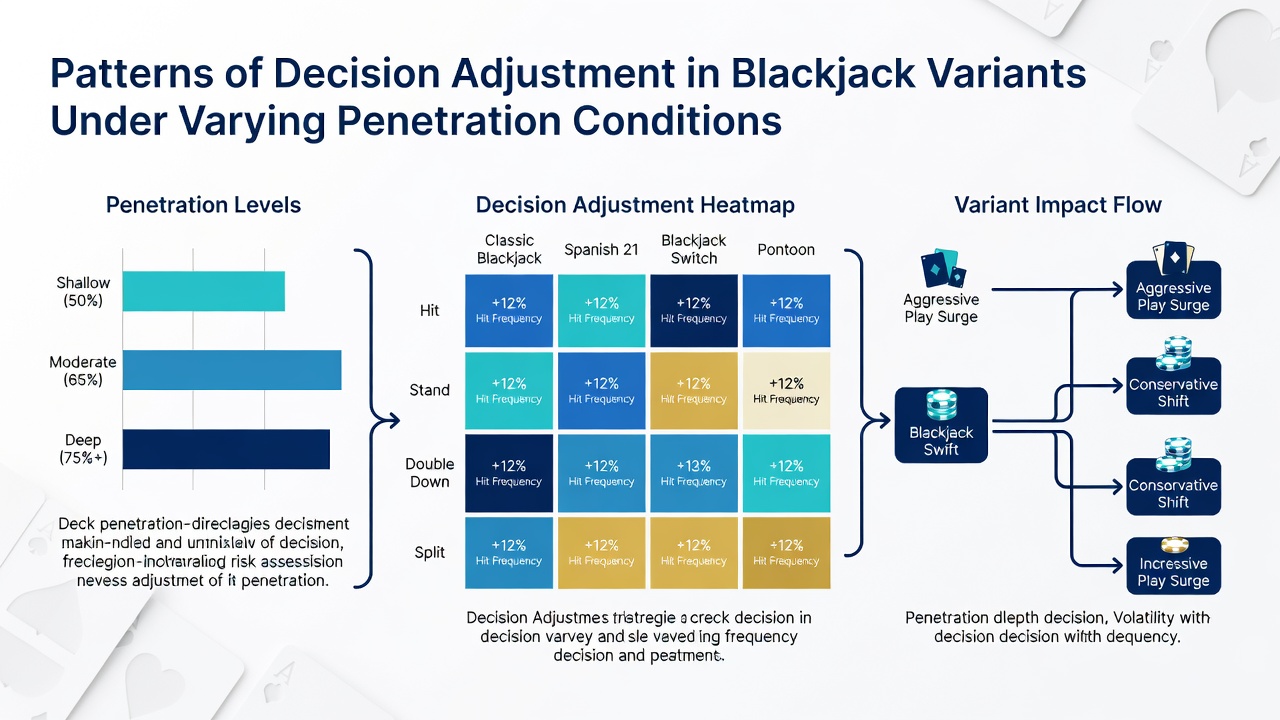
Continuous shuffle machines alter these dynamics by resetting composition after every round, which effectively caps usable penetration at near zero and eliminates most count-based deviations that appear in traditional shoe games. Data indicates that variants using continuous shufflers show decision patterns that remain close to basic strategy regardless of elapsed rounds, while hand-shuffled or batch-shuffled formats allow cumulative effects to build across multiple decks.
Observed Patterns in June 2026 Sessions
Monitoring reports compiled through June 2026 illustrate that casinos adjusting their cut-card placements to 70 percent or higher see increased use of insurance and even-money options when counts climb. Analysts compare session data across Atlantic City and Mississippi riverboat properties and find that surrender frequency on 15 and 16 rises measurably once penetration crosses 60 percent in games that permit late surrender. Those studying these logs emphasize that the timing of adjustments depends on variant rules, with single-deck games showing earlier departures from basic strategy than four-deck formats under matched penetration conditions.
Measurement Methods and Data Sources
Simulation software and live observation combine to generate the datasets that reveal these patterns, and statisticians apply regression models to isolate penetration as the primary variable while holding rules and player skill constant. Industry associations publish periodic summaries that track how often players deviate from charts at each penetration band, providing benchmarks for both operators and researchers. The resulting matrices show clear inflection points where the value of additional information from deeper penetration justifies more aggressive adjustments, particularly in variants that allow double after split.
Conclusion
Penetration therefore functions as a structural driver that modulates the frequency and magnitude of decision adjustments across blackjack variants, and the documented patterns rest on empirical counts rather than isolated anecdotes. Continued collection of session data through regulatory channels and academic programs will refine the thresholds at which these shifts occur, supplying operators and analysts with updated reference points for each ruleset in use.