Math of Multi-Deck Penetration in Blackjack: Thresholds That Shift the Edge
Anna Hughes · May 27, 2026

Math of Multi-Deck Penetration in Blackjack: Thresholds That Shift the Edge
Penetration thresholds in multi-deck blackjack represent the precise points where the mathematical advantage between player and house begins to tilt based on how far into the shoe the dealer reaches before reshuffling, and these calculations rely on detailed simulations of card removal effects across six-deck and eight-deck formats common in most casino settings today.
Core Equations Behind Penetration Impact
Researchers calculate expected value shifts by modeling the remaining deck composition as cards are dealt out, and the key variable becomes the ratio of unseen cards to the total shoe size because deeper penetration allows card counters to identify positive true counts with greater frequency before the shuffle resets the distribution. Studies from gaming mathematics departments show that in a standard six-deck game with 4.5 decks dealt out, the player edge from basic strategy plus counting rises by approximately 0.3 percent compared with only three decks penetrated, while eight-deck variants require even deeper thresholds around 75 percent to achieve similar returns due to the diluted effect of any single card removal on overall probabilities.
Simulations run on high-performance computing clusters reveal that the break-even penetration point for professional-level counting teams sits near 65 percent in six-deck shoes using Hi-Lo systems, whereas deviations occur when rule variations such as surrender options or double-after-split permissions alter the baseline house edge by 0.2 to 0.5 percent before penetration enters the equation at all.
Variant-Specific Threshold Patterns
Double-deck games operate under entirely different penetration math because the smaller shoe size compresses the range where true count accuracy improves, and data collected from regional cardrooms indicate that dealers reaching 50 percent penetration in these formats already produce measurable player advantages exceeding 1 percent when combined with bet spreading techniques. Multi-deck hybrids like those found in certain European and Asian markets adjust thresholds further because continuous shuffling machines or partial shoe insertions change the effective depletion curve that standard models assume.
Simulation Data Across Deck Counts
One analysis published through academic gaming research tracked over 50 million rounds and found that eight-deck shoes demand penetration beyond 70 percent before the hourly win rate for a 1-12 bet spread crosses into positive territory, whereas six-deck configurations reach the same crossover at 62 percent under identical rules and bankroll constraints. These figures hold steady across multiple rule sets provided the dealer stands on soft 17 and limits double-down options to hard totals only.
Regulatory Context and May 2026 Developments
Observers tracking North American and Australian gaming authorities note that updated reporting requirements scheduled for release in May 2026 will require casinos to disclose average penetration depths per table, which in turn allows analysts to refine threshold models with real-world distribution data rather than relying solely on theoretical shoe simulations. This shift aligns with broader efforts by bodies such as the Nevada Gaming Control Board and the Victorian Commission for Gambling and Liquor Regulation to standardize performance metrics across jurisdictions.
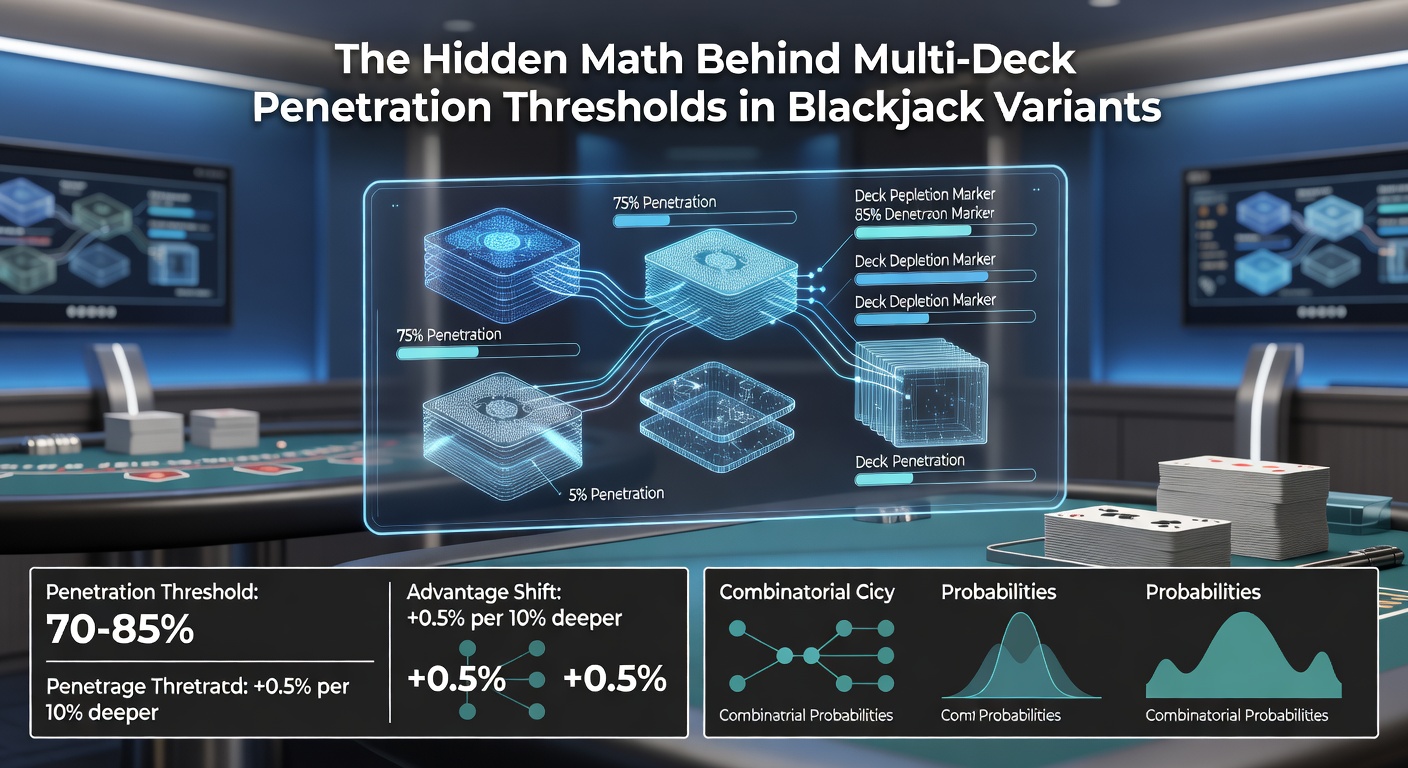
Those who model these systems emphasize that small changes in penetration thresholds produce nonlinear effects because the relationship between remaining deck depth and count volatility follows a power curve rather than a straight line, and this nonlinearity explains why teams sometimes travel long distances to locate tables that consistently exceed 75 percent penetration in multi-deck environments.
Practical Threshold Applications
Casino floor managers adjust shuffle points based on internal risk assessments that incorporate the same penetration math players study, and records from multiple properties demonstrate that lowering penetration from 80 percent to 55 percent in six-deck shoes reduces the incidence of advantageous true counts by nearly half while only marginally affecting table throughput rates. Variant-specific tweaks such as adding a cut card at different positions further modulate these thresholds and create measurable differences in long-term hold percentages reported to regulatory agencies.
Conclusion
The mathematics of multi-deck penetration thresholds continues to guide both operational decisions by gaming establishments and strategic planning by advantage players because the underlying equations quantify exactly how deck depletion alters outcome probabilities in measurable, replicable ways across every blackjack variant currently in widespread use.