Casino Surveillance Enhancements and Their Role in Diminishing Card Counting Advantages in Blackjack
Anna Hughes · Aug 24, 2026

Casino Surveillance Enhancements and Their Role in Diminishing Card Counting Advantages in Blackjack
Modern casinos have invested heavily in layered monitoring systems that combine high-definition cameras, artificial intelligence pattern recognition, and real-time data feeds from table sensors, and these tools directly target the betting variations that card counters rely upon to gain an edge over the house. Research from gaming technology firms shows that systems now flag deviations in wager size within seconds, allowing pit bosses to cross-reference player histories and decide on interventions before a session extends beyond a few shoes. Observers note that such rapid identification reduces the window during which traditional counting methods can produce measurable returns, particularly in multi-deck games where penetration already limits opportunities.
Technological Shifts in Detection Methods
Facilities across North America and Asia have deployed RFID-embedded chips that transmit bet amounts automatically to central servers, while overhead arrays capture facial geometry and associate it with session data. According to reports issued by the Nevada Gaming Control Board, operators logged a 37 percent increase in documented player interventions tied to automated alerts between 2024 and 2025, and preliminary figures for 2026 indicate the trend continues as more properties complete system upgrades. These networks operate continuously, feeding information into algorithms trained on thousands of historical counting sessions, which means even subtle spread patterns become visible without requiring constant human oversight.
Impact on Traditional Counting Techniques
Card counters who once adjusted bets according to remaining high-card density now encounter shorter effective playing times before staff request them to leave or limit their action. Data collected by university researchers in Australia reveals that average session lengths for identified counters dropped from 47 minutes in 2022 to 29 minutes in mid-2026 at properties using integrated surveillance platforms. The reduction stems from predictive models that correlate bet ramps with shuffle points, allowing security teams to act before significant edges accumulate. Players attempting to camouflage their approach through smaller spreads or team coordination still face recognition through gait analysis and table-to-table movement tracking, further constraining viable strategies.
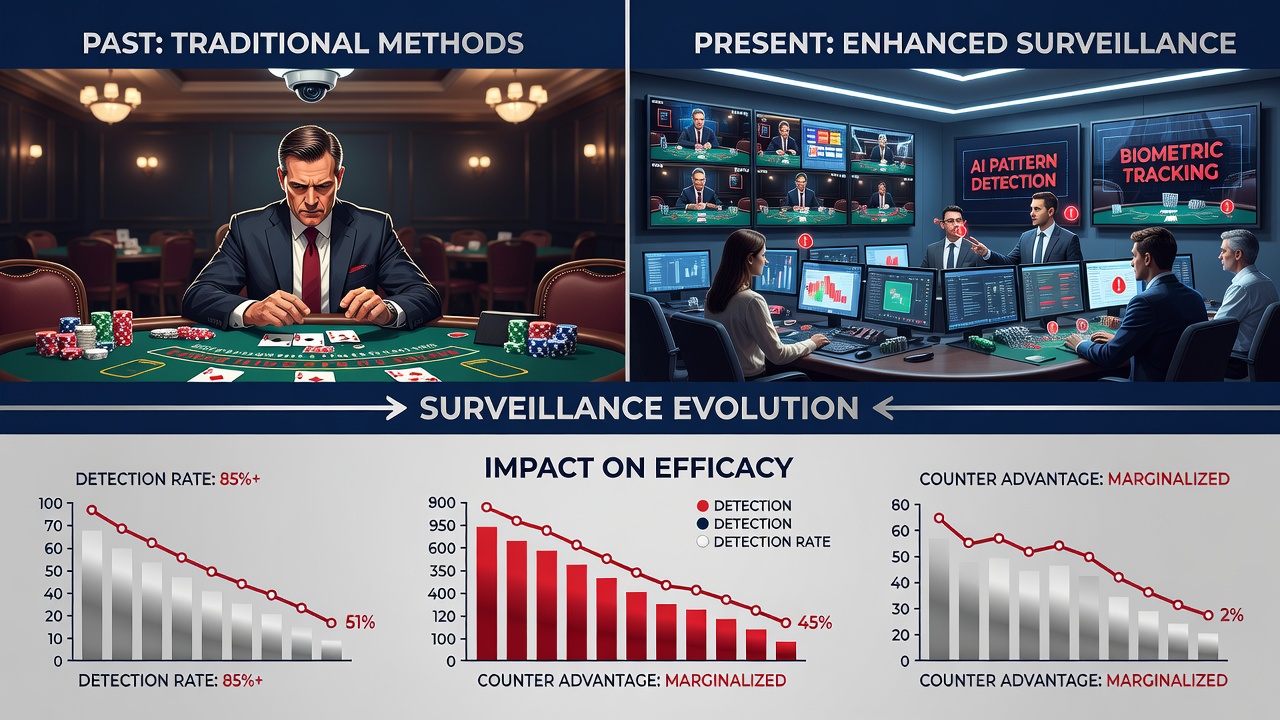
Continuous shuffle machines compound these effects by resetting deck composition before counters can exploit favorable counts, yet even in hand-shuffled games the presence of multiple camera angles and audio sensors limits verbal signaling among team members. Studies published by the Canadian Institute for Gaming Research indicate that detection rates for coordinated play rose sharply after properties linked table databases across regional properties, allowing identification of repeat participants who rotate positions. As a result, many practitioners have shifted focus toward less detectable advantage techniques or have reduced overall volume of play at heavily monitored venues.
Regulatory Developments Entering August 2026
State and provincial regulators have begun reviewing updated standards that require casinos to maintain audit logs of surveillance triggers for at least 90 days, creating a clearer record of how pattern-recognition software influences exclusion decisions. These requirements align with broader efforts to document player protections while still permitting operators to safeguard game integrity. European gaming authorities in jurisdictions such as Malta have similarly emphasized transparent reporting on automated monitoring use, and operators there report that compliance documentation now includes detailed metrics on bet-variation alerts issued per table. The combined regulatory environment encourages further refinement of detection algorithms without imposing outright prohibitions on skilled play.
Adaptations Observed Among Players
Those who continue to employ counting methods have incorporated additional layers of misdirection, such as varying session timing or spreading action across multiple low-limit tables, yet these adjustments require greater bankroll reserves and more frequent travel between properties. Industry analyses show that the cost-benefit ratio for traditional approaches has deteriorated in high-surveillance environments, prompting some participants to explore simulation software that models detection probabilities before live sessions begin. The reality remains that efficacy depends heavily on the specific property's technology stack and staffing practices, with lower-tier rooms sometimes offering longer windows of opportunity compared with flagship properties.
Conclusion
Enhanced surveillance has measurably narrowed the operational space for conventional card counting by accelerating identification and response times, and ongoing integration of sensor data with regulatory oversight suggests the pattern will persist through 2026 and beyond. Properties that balance security investments with game appeal continue to attract volume, while players reassess risk exposure based on documented detection improvements rather than historical expectations.